One thing I am noticing here is how different the context of ministry is from country to country.

MNN's Ruth Kramer on assignment.
You can sometimes THINK you understand the concept of the vehicle, like micro-enterprise, but once you hear how things are put into practice, what works and what doesn’t, you begin to see the subtleties emerge.
For example, we met with a partner yesterday who assists community development. They are unashamedly Christian, because the Gospel is part of everything they do…however, they know that dealing with poverty is a ‘must’, as well.
So, which came first, the chicken (community development) or the egg (Gospel)? Can they be done simultaneously and be effective? Do you really just have two eggs or two chickens?
The clear answer on that was: ‘We have an egg, it becomes a chicken’. Folks, that’s the answer to the question of questions. The hope of Christ changes the outlook for the poor in this context.
The other big question was how the community development works in the Egyptian Muslim context in the rural areas. It is in these places where it’s likely opposition will rise up and equate physical attacks. The mindset is quite different.
Micro-enterprise comes up at this point. In some Asian countries, the structure of a micro-enterprise program works like this: church committee sees community member in need (often a believer under the discipleship of the pastor), they provide a loan so this person can start a small business–i.e.—buy a sewing machine to make clothes, or a couple of goats to make cheese and sell milk…from the profits, the person tithes to the church, enabling the support of the pastor…and the person is more able to support him/herself.
However, when I asked about the structure of the micro-enterprise, it can’t work that way in the Egyptian context. There are lots of things that can really be misinterpreted within the social structure (and Islam) and this is one of them.
The set up of the program is similar, but different because it’s tailor-made to fit the need of the people and the mission of the group. That just struck me. I had made an assumption that all micro-enterprise was the same.
I made similar assumptions about vocational training programs, literacy programs, etc (thinking I adjusting for a different context, language, etc). I think it’s kind of a colonialistic thinking that we slip into.
It’s kind of like providing someone a loaf of bread (mission field)…from the grocery store (missionary). They need the food to stay alive, but the plastic around the bread is giving them indigestion. They need to prepare the bread the way they now how and all we need to do is supply the ingredients (resources) and the recipe (training).
Yes, I know you might be thinking ‘well, duh’. It is one thing to say it and to think you might even understand it, it is another thing entirely to actually see it with my own eyes, hear what works and what doesn’t from the guys implementing helps.
By the way, because they do this work well, they have just come under scrutiny. One of this ministry’s main offices was raided by the Egyptian government this week, and the hard drive with the database was taken.
All of their records on every program were on it. Everything is exposed. Their face is an NGO and they are well-known. With the events that have occurred in Egypt over the last month, it’s no surprise they’re looking at all NGO’s.
Please pray for this team. They are careful, and they are smart. Most of all, they want to share the hope of Christ with those they encounter. That love for people permeates everything they touch…including the chickens in the coop…and eggs in the community. Works for me…




 The morning started with greetings from the All-Ukrainian Union of Evangelical Christians Baptists, Bible Society of Ukraine, Feollowship of Independent Churches and Missions in Ukraine, Light in the East Mission and others. Without a break, Alexei Melnichuk, President of Connect International, began talking about the need for Christians to stop fighting over traditional and contemporary churches and evangelism. He says, “Coming to Christ is the most important thing. So, we need to stop focusing on who’s right and who’s wrong and go reach the lost where they live.”
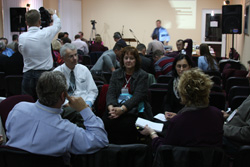 I attended the Social Evangelism small group. Many attended this. Because there were so many, we split up into smaller groups to foster more interaction. Here are the top five social issues based on the discussion in the CIS — HIV/AIDS, drug/alcohol abuse, crime, lack of moral values, and the growing orphan population.
 Following these small groups, Russian Ministries dedicated their new ministry center, the site of the forum. Russian Ministries Vice President Sergey says this center will be key for outreach. “This has become a ministry nerve center, not just for Ukraine, but for all the former Soviet Union and even farther. I truly believe that this place will be the place for new initiatives to be developed, new vision will be offered and new strategic ministries will be started.”